Storyblok FlowMotion: The Complete Guide to CMS Content Automation

Key takeaways:
- FlowMotion is Storyblok's native automation layer, built on n8n, that turns content events into coordinated workflows across your entire tech stack.
- It is available on Business+ plans and above, with 500+ pre-built integrations and native AI nodes for OpenAI, Anthropic, and self-hosted LLMs.
- The value of FlowMotion depends on the quality of your content architecture. Poorly structured content produces unreliable automations.
- Practical first workflows include automated translations, asset tagging, social post generation, and multi-system product launch coordination.
Storyblok shipped FlowMotion to general availability on 24 April 2026. For a platform that has historically focused on content structure and editorial experience, this is a significant move. FlowMotion gives Storyblok a native automation layer, one that sits inside the CMS rather than bolted on through external middleware.
The timing makes sense. Storyblok's own research puts the number at 75% of marketers losing at least one full workday per week to content coordination. That includes chasing translations, republishing across markets, syncing product data, and manually triggering downstream systems after a content update.
These are not creative tasks. They are operational overhead, and they scale linearly with every new market, brand, or channel an organisation adds.
We were invited to test FlowMotion ahead of GA. As a Storyblok Platinum partner and UK and Ireland Agency of the Year, we've spent over a decade building and optimising headless CMS platforms for enterprise organisations. Our perspective here is practical. We've seen where automation works, where it fails, and what it actually requires from the content layer underneath.
This is a technical walkthrough of what FlowMotion does, where it fits in a modern content stack, and what your content architecture needs to look like before you can get real value from it.
What FlowMotion actually does
FlowMotion is an event-driven workflow engine embedded inside Storyblok, built on n8n, the open-source automation platform. Every content event in Storyblok (publish, unpublish, create, update, move, delete) can serve as a trigger for multi-step, multi-system workflows.
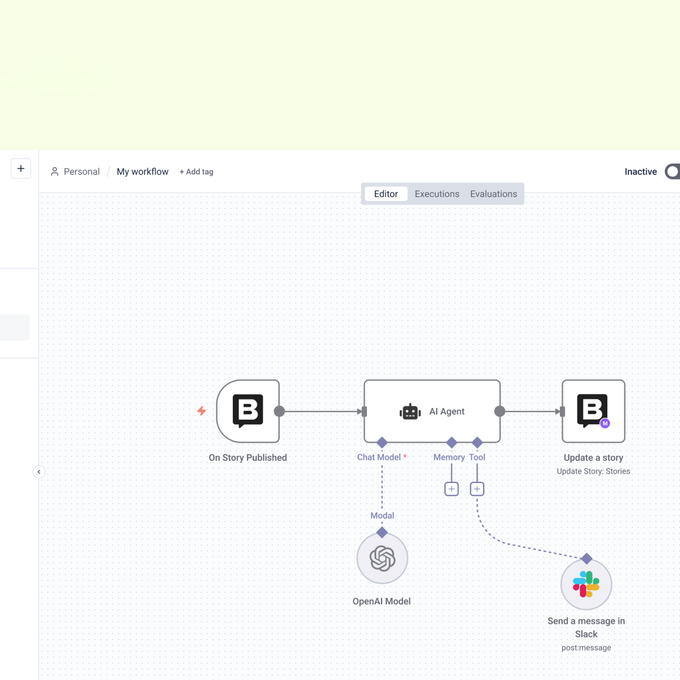
The practical scope is broad. FlowMotion ships with 500+ pre-built integrations covering CRMs, marketing platforms, DAMs, commerce systems, analytics tools, and notification services. It also includes native Storyblok API nodes, meaning workflows can read, write, and transform content directly within the CMS without requiring external API calls or custom middleware.
The FlowMotion documentation covers the full list of available triggers and actions.
The workflow builder is visual. You drag nodes, connect them, and configure each step. For teams that need more control, every node exposes a code fallback where you can write custom JavaScript or use expressions to transform data between steps.
The technical capabilities go beyond simple "if this, then that" chains. FlowMotion supports conditional and branching routing through n8n's split-filter-merge node architecture. A single content event can fan out into parallel paths based on content type, locale, status, or any field value in the story. Branches can converge back into shared steps downstream.
Approval workflows are built in. Content can be routed to reviewers with feedback capture at each stage, and SLA nudges can fire to Slack, Microsoft Teams, or email when reviews stall. This is particularly useful for multi-market organisations where regional compliance or legal review gates are mandatory.
Native AI nodes round out the feature set. FlowMotion includes direct integrations for OpenAI, Anthropic, and self-hosted LLM endpoints. AI steps sit inside the workflow as first-class nodes, meaning you can chain them with content reads, conditional logic, and downstream publishing without leaving the Storyblok environment.
Five workflows worth building first
The temptation with any new automation tool is to try to automate everything at once. That rarely works. These five workflows represent the highest return-on-effort starting points we've identified from our early testing.
Automated translation and localisation
Content is published in the primary locale. FlowMotion detects the publish event, reads the story content, sends it to a translation service (DeepL, Google Cloud Translation, or a custom LLM endpoint), and writes the translated content back into the appropriate locale folders in Storyblok.
The critical detail: this only works reliably when your content model separates translatable text from structural and presentational components. Flat, monolithic rich text fields produce messy translations. Granular, field-level content models let the automation target exactly the right strings.
For organisations operating across 10+ markets, this workflow alone can eliminate days of manual coordination per content cycle.
Product launch coordination
A product launch typically touches multiple systems: the CMS for landing pages and editorial content, the commerce platform for product data, the CRM for campaign triggers, the DAM for asset distribution, and notification channels for internal teams.
FlowMotion can orchestrate this as a single workflow. A content manager publishes the launch story in Storyblok. FlowMotion then pushes product metadata to the commerce layer, triggers a HubSpot or Salesforce campaign sequence, distributes hero assets to the DAM, and posts a structured notification to Slack or Teams with links to every published asset.
The branching logic matters here. Different product categories may require different approval gates, different regional variants, or different downstream systems. n8n's split-filter-merge architecture handles this without duplicating entire workflows.
AI content enrichment
Every story published in Storyblok contains structured data. FlowMotion can pass that structured data to an AI node on publish, generating SEO metadata, social summaries, alt text for images, or structured FAQ content derived from the body copy.
We've been testing this with Anthropic's Claude via the native AI node. The key is prompt design that references specific fields from the content model rather than dumping the entire story as unstructured text. A well-structured content model with discrete fields for headline, summary, body sections, and key points produces dramatically better AI outputs than a single rich text block.
The generated content can be written back to dedicated fields in Storyblok, reviewed by an editor (with approval workflow gates), and published in a single automated chain.
Post-publish SEO automation
After a story is published, FlowMotion can trigger a sequence of SEO-related actions: submitting the URL to Google's Indexing API, purging the CDN cache for that path, updating the XML sitemap, and pinging analytics or rank-tracking tools to begin monitoring the new URL.
For organisations with large content estates (hundreds or thousands of pages), manually managing index submissions and cache invalidation after every publish is unsustainable. Automating this ensures every published piece of content is immediately discoverable.
Combined with Storyblok Strata, which adds semantic meaning to content for AI readiness, post-publish automation can also push structured data to knowledge graph endpoints or AI training pipelines.
Multi-market content governance
Organisations operating across multiple markets often need content to pass through regional compliance, legal review, or brand approval before it can go live in a specific locale.
FlowMotion enables governance workflows that route content to the correct reviewers based on the target market, content type, or specific field values (e.g. any content mentioning pricing or regulatory claims). Reviewers receive notifications with direct links to the content in Storyblok's visual editor. Feedback is captured within the workflow. SLA timers escalate stalled reviews.
This pairs well with Storyblok's Release Merging, shipped in January 2026, which allows teams to stage and merge batched content changes. FlowMotion handles the governance and notification layer; Release Merging handles the content staging and deployment.
How FlowMotion compares to external automation tools
The obvious comparison is with Zapier, Make (formerly Integromat), and standalone n8n instances. All of these can connect to Storyblok via webhooks and API calls. Many organisations already have them in their stack.
FlowMotion's advantage is native access to Storyblok's content model. External tools receive webhook payloads, which are flat JSON representations of a content event. They can react to "a story was published" but they cannot natively traverse the content tree, resolve relationships between stories, access draft content, or write back to specific fields without custom API integration work.
FlowMotion operates inside Storyblok's data layer. Workflows can read any field from any story, follow content relationships, access folder structures, and write directly to the content API with full schema awareness. This eliminates an entire class of integration middleware that organisations typically build and maintain themselves.
Capability | FlowMotion | Zapier / Make | Standalone n8n |
|---|---|---|---|
Content model awareness | Native, full schema access | Webhook payload only | Webhook payload only |
Write back to CMS fields | Direct, schema-validated | Custom API integration | Custom API integration |
Approval workflows | Built-in with feedback capture | Requires external tooling | Requires custom build |
AI nodes | Native (OpenAI, Anthropic, LLMs) | Available via integrations | Available via community nodes |
Integration breadth | 500+ (via n8n) | 6,000+ | 500+ (community nodes) |
Platform scope | Storyblok only | Any platform | Any platform |
The trade-off is clear. FlowMotion is Storyblok-specific. Organisations that need to automate workflows across multiple CMSs, or that have complex orchestration requirements beyond content operations, will still need a general-purpose tool.
FlowMotion does not replace Zapier or Make for non-content workflows. It replaces the content-specific automations that those tools handle poorly because they lack native CMS context.
What FlowMotion needs from your content architecture
This is the part most organisations will underestimate. Automation quality is directly tied to content architecture quality. FlowMotion can only act on what Storyblok's content model exposes.
A content model built with flat, unstructured rich text fields gives FlowMotion very little to work with. A model with discrete, typed fields for every meaningful piece of content gives FlowMotion granular control over what gets translated, enriched, validated, routed, and published.
We've spent ten years building and restructuring content models for enterprise organisations. The pattern is consistent: teams that invest in content architecture get compounding returns from every tool that sits on top of it. Teams that skip this step spend their time working around limitations.
Content architecture checklist for FlowMotion readiness:
- Content is broken into granular, typed fields (not monolithic rich text blocks).
- Translatable content is separated from structural and presentational components.
- Content relationships (references between stories) are explicit and consistent.
- Folder structures map to meaningful organisational boundaries (markets, brands, content types).
- Naming conventions are consistent across components and stories.
- Approval states and workflow stages are modelled as content fields, not managed externally.
- SEO and metadata fields exist as discrete, addressable components.
Organisations that have already invested in structured content, particularly those working with Storyblok Strata for semantic enrichment, will find FlowMotion significantly more powerful out of the box. Organisations with legacy content models should plan a restructuring exercise before attempting complex automations.
Pricing and availability
FlowMotion is available on Storyblok Business+ plans and above. It shipped to general availability on 24 April 2026.
Storyblok has not publicly priced FlowMotion on a per-flow or per-execution basis at the time of writing. Pricing is bundled within the plan tier. Organisations considering FlowMotion should confirm current pricing and execution limits directly with their Storyblok account team, particularly for high-volume automation scenarios across multiple markets.
Where we stand
FlowMotion is the most significant addition to the Storyblok platform in recent memory. A native automation layer that understands the content model is fundamentally more capable than external middleware connected via webhooks.
For organisations evaluating Storyblok against other enterprise CMS platforms, FlowMotion resolves the question of whether the platform can handle complex operational workflows.
We're still in the early stages of discovering what's possible. Every conversation with our clients uncovers another process that could be simplified, another manual handoff that could disappear. The visual builder is accessible to non-developers, and the code fallback gives technical teams the control they need for complex logic.
For teams that want to move quickly, we'd recommend starting with one high-value workflow (translation or post-publish SEO), proving the pattern, and expanding from there. We're building FlowMotion implementations for enterprise clients now, and the early results are encouraging.
Frequently asked questions
What is Storyblok FlowMotion?
FlowMotion is Storyblok's native workflow automation engine, built on the open-source n8n platform. It allows content events (publish, update, delete) to trigger multi-step, multi-system workflows directly inside Storyblok, with 500+ integrations and native AI capabilities.
Which Storyblok plans include FlowMotion?
Which Storyblok plans include FlowMotion?
FlowMotion is available on Business+ plans and above. It shipped to general availability on 24 April 2026.
Does FlowMotion replace Zapier or Make?
For content-specific automations, FlowMotion is more capable because it has native access to the Storyblok content model. External tools like Zapier and Make are still better suited for non-content workflows or cross-platform orchestration that extends beyond Storyblok.
Do I need to restructure my content before adopting FlowMotion?
FlowMotion's effectiveness depends directly on your content architecture. Granular, well-typed content models produce reliable automations. Flat or unstructured content models produce inconsistent results. Auditing and restructuring your content model before building complex workflows is strongly recommended.