Adobe Experience Manager vs Storyblok: What enterprise teams need to know

AEM dominated enterprise content management for over a decade. That dominance is ending.
In the 2025 Gartner Magic Quadrant for Digital Experience Platforms, Optimizely displaced Adobe as Leader after five consecutive years at the top. Gartner cited premium pricing, a complex product portfolio, and a steep technical learning curve as specific concerns.
The shift is not surprising. Enterprise teams that once accepted AEM's complexity as the cost of doing business are now questioning whether that cost is justified. Storyblok represents a fundamentally different approach: headless-first, API-driven, built for composable architecture from the ground up.
This comparison is written from direct delivery experience. Anything is a Storyblok Platinum Partner and UK and Ireland Agency of the Year, with over a decade of headless CMS experience that includes migrating enterprise organisations from AEM to modern headless platforms. The assessment that follows is grounded in what we have seen work, and where both platforms fall short.
AEM vs Storyblok at a glance
Capability | Adobe Experience Manager | Storyblok |
|---|---|---|
Architecture | Monolithic DXP with added headless capabilities (Content Fragments, GraphQL API). Core remains a Java application. | Headless-first, API-driven. Built composable from the ground up. |
Content editing | Two coexisting editors (legacy Page Editor and Universal Editor). Most changes require developer involvement. | Real-time Visual Editor with inline editing, drag-and-drop, and live preview. Editors work independently. |
Developer experience | Java/OSGi/Sling stack. Local development requires JDK, SDK download, Maven builds. Significant onboarding time. | Framework-agnostic. CLI setup demonstrated in 49 seconds at RenderATL 2025. REST and GraphQL APIs. |
Pricing model | Custom-quoted. No published list prices. Practitioner estimates: $200,000 - $300,000+ annually for full AEMaaCS deployments. | Published tiers. Free Starter, $99/month Growth, custom Enterprise. Transparent and predictable. |
Multi-site and multi-brand | Native Multi-Site Manager (MSM) with live copies and inheritance. Powerful but rigid. | Folder-based architecture with role-based access. Flexible but requires upfront planning. |
Performance | Dispatcher-based caching adds complexity. Traditional rendering model. | API-first delivery to edge-optimised frontends. 30 - 50% faster page loads vs monolithic CMS. |
AI readiness | Adobe's AI investments (Firefly, GenStudio) focus on asset generation. No named content structure or discoverability product. | Strata content observability layer with AI-readiness framework. Multi-year AWS partnership for FlowMotion AI experiences. |
Best suited for | Organisations fully embedded in the Adobe ecosystem (Creative Cloud, Analytics, Target, Campaign). | Enterprise teams that need speed, flexibility, lower TCO, and composable architecture. |
The core trade-off is straightforward. AEM offers deep Adobe ecosystem integration at significant cost and complexity. Storyblok offers flexibility, speed, and lower total cost of ownership for teams ready to adopt composable architecture.
Architecture and approach
AEM's architectural split
AEM is not one product. It ships as two distinct lines with different cost structures, release cadences, and operational models.
AEM 6.5 LTS is the on-premise and Adobe Managed Services (AMS) hosted version. Released in Spring 2025, it provides extended support for organisations not yet moving to cloud. Some teams refer to it informally as "AEM 6.6."
AEM as a Cloud Service (AEMaaCS) is the cloud-native version. It operates on a continuous delivery model where updates ship automatically without customer-controlled release cycles. For enterprise teams accustomed to managing their own release windows, this creates change management challenges that often go unacknowledged in vendor presentations.
Adobe has added headless capabilities to both versions through Content Fragments and a GraphQL API. The core, however, remains a monolithic Java application.
Teams that adopt AEM's headless features frequently end up maintaining both traditional page authoring and headless content delivery in parallel. This dual approach doubles complexity without delivering the architectural simplicity that a headless-first platform provides.
Most comparisons treat AEM as a single product. That conflation causes real confusion during procurement. The cost, operational model, and migration path differ significantly between AEM 6.5 LTS and AEMaaCS.
Storyblok's headless-first model
Storyblok was built headless from the ground up as an enterprise-grade headless CMS. There is no legacy monolith underneath, no hybrid mode, and no "traditional" authoring layer that coexists awkwardly with an API.
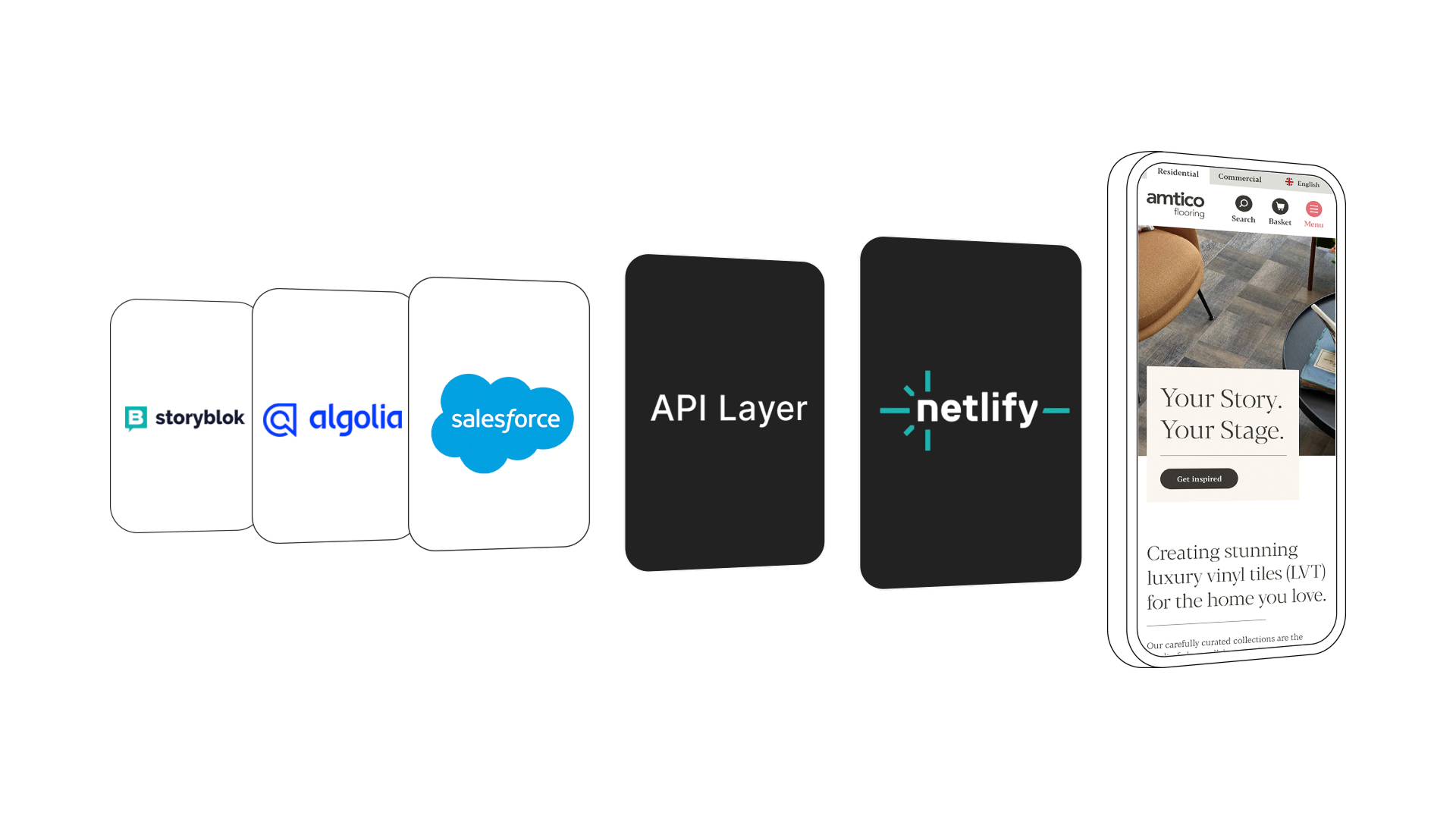
Content is structured as reusable components and delivered via REST or GraphQL API to any frontend framework. This is composable by default: Storyblok integrates with any frontend, commerce platform, or marketing tool without requiring vendor lock-in to a single ecosystem.
The developer experience gap is measurable. At RenderATL 2025, Storyblok's CLI setup was demonstrated live on stage in 49 seconds. AEM local development requires a Java JDK, local SDK download, Sling model configuration, and Maven build tooling before a developer writes a single line of content delivery code.
This architectural difference is not academic. It determines how quickly teams ship, how easily they integrate new tools, and how much ongoing maintenance the platform demands. (For a similar comparison involving another legacy DXP, see our Sitecore vs Storyblok comparison.)
Content editing and team usability
What editing looks like in AEM
AEM currently operates with two coexisting editors: the legacy Page Editor and the newer Universal Editor. This dual state creates confusion for editorial teams and adds training overhead during transitions.
The deeper issue is developer dependency. Most content changes in AEM require developer involvement.
Component configuration, template updates, and workflow modifications are not self-service tasks. Publishing workflows involve multiple steps and approvals that slow down time-to-market for routine content updates.
This is not an exaggeration. AEM practitioner communities consistently confirm that developer dependency for everyday content changes is one of the primary frustrations driving migration conversations. When marketing teams cannot publish a campaign landing page without raising a development ticket, the platform is working against them.
AEM's editors are functional. The problem is not capability in isolation. The editorial workflow itself demands technical resources for tasks that modern platforms handle through self-service interfaces.
Storyblok's Visual Editor
Storyblok's Visual Editor is widely regarded as the strongest in the headless CMS market. It is the primary reason many enterprise teams choose Storyblok over alternatives like Contentful, Sanity, and Contentstack.
Editors see exactly what the published page looks like while making changes. Inline editing happens in real time with live preview. Components are placed and rearranged through drag-and-drop without developer involvement.
Content teams gain independence.
Built-in collaboration features support concurrent editing across teams. A dedicated translation view handles multi-language content workflows without duplicating entire pages or requiring external localisation tools.
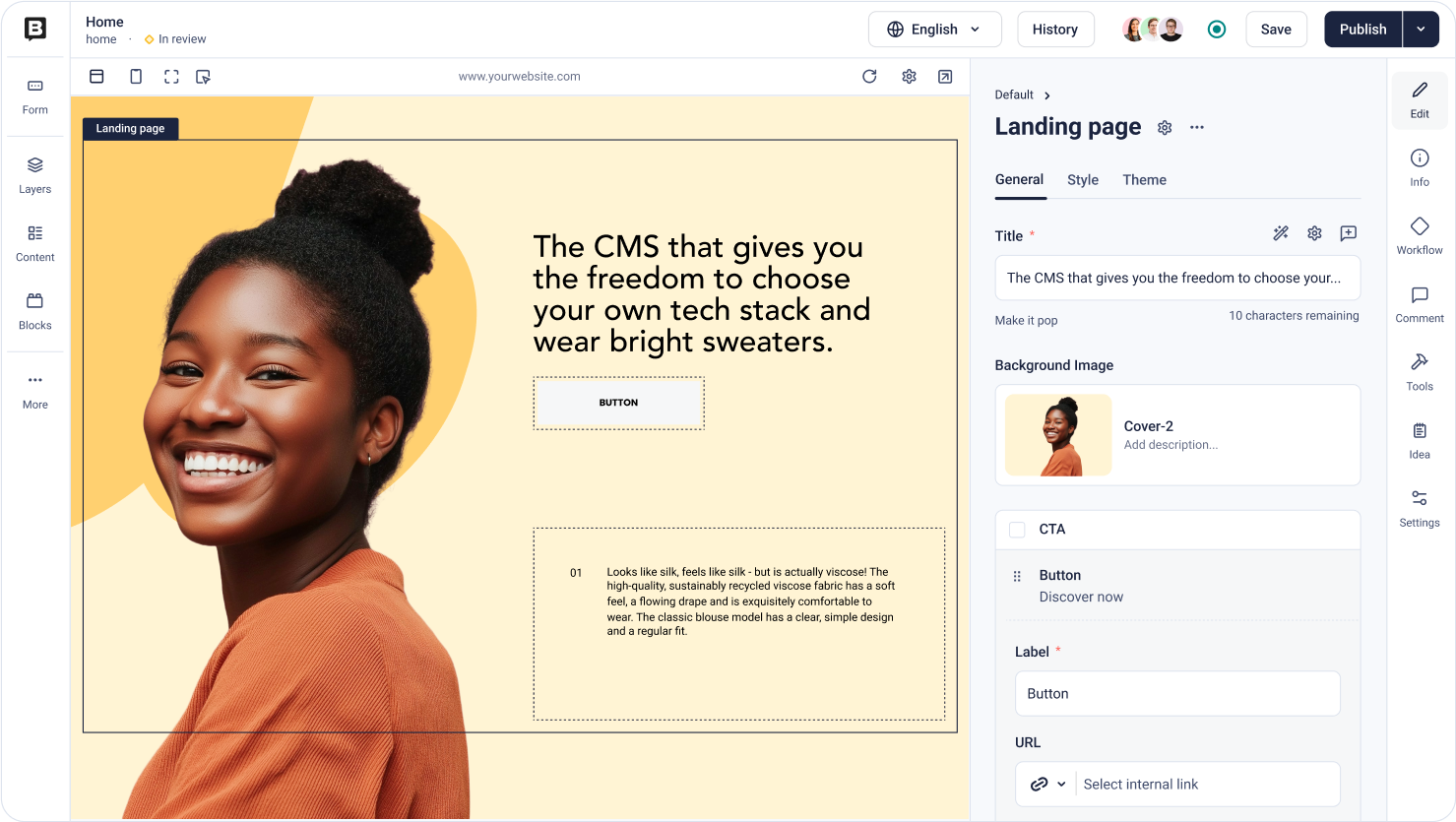
The Visual Editor transforms the editorial relationship with the CMS. Content teams stop waiting for development tickets and start publishing on their own terms. For enterprise organisations where content velocity directly affects revenue, that shift is significant.
Total cost of ownership
Enterprise CMS costs break into three buckets: platform licensing, implementation, and ongoing operations. The gap between AEM and Storyblok is significant across all three.
Licensing
Adobe does not publish list prices for AEM. All pricing is custom-quoted based on usage, consumption, integrations, and organisation size.
Practitioner estimates place AEM Sites licensing at $60,000+ (£48,000+) per year for the base product, with full AEM as a Cloud Service deployments ranging from $200,000 to $300,000+ (£160,000 to £240,000+) annually.
Storyblok Enterprise licensing starts from around $55,000+ (£40,000+) annually, though it varies depending on requirements such as the number of spaces, users, API volume, and SLA level. The published tier structure provides a baseline that AEM does not offer.
AEM licensing alone can exceed $200,000 (£160,000) per year before a single page is built. Storyblok Enterprise starts at roughly a quarter of that figure for equivalent capability.
Implementation
Enterprise AEM deployments typically require $500,000 to $1,000,000 (£400,000 to £800,000) in implementation partner fees. The Java/OSGi/Sling technology stack demands specialist developers who command premium rates, and the talent pool is shrinking as the broader developer market moves toward JavaScript-based frameworks.
Storyblok implementation starts from around $185,000 (£150,000), with a typical enterprise project costing approximately $310,000 (£250,000). Modern developer tooling, framework-agnostic APIs, and shorter setup times compress project timelines significantly compared to AEM.
Ongoing operations
AEM support contracts add 15 - 25% of licensing costs annually. Server patching, dispatcher configuration, Java dependency management, and AEM-specific infrastructure maintenance create ongoing operational overhead.
Storyblok's operational burden is minimal: no server patching, no Java dependency management, no dispatcher configuration. The platform is fully managed. Ongoing costs shift from infrastructure management to content operations, which is where enterprise teams should be investing.
The full picture
Cost bucket | AEM (enterprise estimate) | Storyblok (enterprise estimate) |
|---|---|---|
Annual licensing | $200,000 - $300,000+ (£160,000 - £240,000+) | From ~£40,000 annually |
Implementation | $500,000 - $1,000,000 (£400,000 - £800,000) | From $185,000 (£150,000), typical ~$310,000 (£250,000) |
Ongoing operations | 15 - 25% of licence + infrastructure | Minimal (fully managed platform) |
Specialist staffing | Premium (Java/OSGi/Sling, shrinking pool) | Standard web development rates |
Gartner cited "premium price" as a specific concern in the 2025 DXP Magic Quadrant. Storyblok is not free at enterprise scale, but the total cost is a fraction of AEM for equivalent capability.
Multi-brand, multi-market, and governance at scale
AEM Multi-Site Manager
AEM's Multi-Site Manager (MSM) is its native tool for managing content across multiple brands, markets, and languages. MSM enables live copies and rollout configurations where child sites inherit content from parent blueprints.
For tightly coupled brand architectures where consistency is paramount, MSM is powerful. Changes to a parent blueprint cascade automatically to all live copies. Global campaigns, shared navigation, and standardised templates propagate without manual intervention.
The limitations emerge at scale. MSM's inheritance model creates rigid dependencies.
Breaking inheritance on a live copy to accommodate a regional variation is a one-way operation that introduces governance risk. Content authoring across multiple sites requires navigating complex site trees and permission hierarchies that grow exponentially with each new market or brand variant.
For organisations with genuinely independent brands that share infrastructure but operate autonomously, MSM's inheritance model is often more constraint than benefit. The rigidity that ensures consistency also prevents the flexibility that independent brand teams need.
Multi-brand AEM instances that have grown organically over several years frequently accumulate governance debt: broken inheritance chains, orphaned live copies, and permission configurations that no single team member fully understands.
Storyblok's approach to multi-site
Storyblok takes a fundamentally different approach. Content is organised through a folder-based architecture within Spaces, with role-based access controls applied at the folder level.
This is a "bring your own structure" model. Storyblok does not impose an inheritance framework. Teams design their own multi-site architecture based on their specific brand relationships, regional requirements, and editorial workflows.
Storyblok's Dimensions app handles localisation variants without duplicating content. A single content entry can have multiple language and regional variants, managed through a dedicated translation view rather than parallel content trees.
The flexibility comes with a requirement: upfront architectural planning. Storyblok's model works best when combined with a well-designed component library that allows brand-specific styling on shared content structures. Anything has helped organisations consolidate multiple global websites into a single platform through this approach.
Without experienced implementation guidance, enterprise teams risk building a folder hierarchy that becomes difficult to govern as the number of brands and markets grows.
For multi-brand, multi-market deployments, the architecture requires an implementation partner who understands the enterprise governance requirements before building starts. The technical setup is straightforward. Information architecture decisions carry the real complexity.
Performance, SEO, and AI discoverability
Core Web Vitals and page speed
The performance gap between headless and monolithic CMS architectures is quantifiable. Headless architectures deliver 30 - 50% faster page loads compared to traditional monolithic CMS platforms, with time to first byte (TTFB) under 200ms versus 500ms or more for traditional setups. CDN latency reductions of 40 - 60% are consistently measured when comparing headless delivery to traditional CMS architectures.
AEM's dispatcher layer adds caching complexity. Configuration, invalidation rules, and cache warming require ongoing specialist attention.
A headless approach with an edge-optimised frontend built on scalable headless CMS architecture, such as Astro or Next.js, eliminates this layer entirely and delivers content through API calls to a CDN-backed edge network.
The real-world outcomes back this up. One UK fashion retailer's migration to a headless CMS architecture delivered a 4x increase in page views per session and a 35% reduction in bounce rate. These are production results, not theoretical benchmarks.
For context, the HTTP Archive Web Almanac 2024 reported that only 40% of WordPress mobile sites pass Core Web Vitals, compared to a 63.4% global benchmark. Traditional CMS architectures consistently underperform against modern headless delivery models, and AEM's dispatcher-based architecture shares many of the same rendering constraints.
Structured content and AI discoverability
AI answer engines, including ChatGPT, Perplexity, and Google AI Overviews, favour content that is structured, semantically tagged, and directly answerable. The CMS platform powering your digital estate directly affects how content is surfaced in these systems.
Headless CMS platforms deliver content as structured data via API. This makes content inherently more parseable by AI systems than page-rendered HTML from traditional CMS platforms where content structure is embedded in presentation markup.
Storyblok's AI vision
Storyblok has a clear, product-led vision for AI across the content lifecycle. This is not a roadmap slide. These are shipping features with a named product strategy behind them.
Strata is Storyblok's content observability layer. It provides an AI-readiness framework spanning Plan, Create, Manage, Deliver, Observe, and Optimise. Strata gives content teams visibility into how content performs after publication, not just how it is created.
AI writing and SEO tools. Storyblok has integrated AI-powered writing assistance directly into the Visual Editor. Content teams can generate drafts, rewrite copy, and optimise content for SEO without leaving the editing interface. This is built into the platform, not bolted on through third-party plugins.
Flowmotion. Built on top of n8n, Flowmotion brings workflow automation into the CMS with over 300 third-party integrations. Content teams can automate publishing workflows, trigger translations, syndicate content across channels, and connect AI-driven processes to their content pipeline. This is practical automation for content operations, not a feature demo.
Storyblok's multi-year strategic collaboration with AWS, announced in December 2025, targets FlowMotion AI experiences at enterprise scale. The investment signals that AI-driven content delivery is central to Storyblok's platform direction.
Where AEM stands on AI
AEM has no equivalent named AI content product. Adobe's AI investments through Firefly and GenStudio focus on asset generation and creative workflows. These are strong tools for design teams, but they do not address content structure, discoverability, or content operations.
Adobe has not articulated a clear AI strategy for content management in the way Storyblok has with Strata and Flowmotion. For enterprise marketing teams, the CMS platform decision made today directly affects how content is surfaced in AI-generated answers over the next three to five years. Storyblok is building for that future. AEM is still working out its approach.
Migration from AEM to Storyblok
Not everything needs to be migrated the same way
The instinct with most CMS migrations is to move everything at once. That is rarely the right approach for AEM. Different content types have different migration needs, and treating them all identically wastes time and misses opportunities.
Structured content sections such as products, news articles, and resource libraries are strong candidates for automated migration. Content stored in structured AEM components or Content Fragments can be extracted from the JCR (Java Content Repository) and mapped programmatically to Storyblok's component model. This is the fastest path for high-volume content.
Landing pages and campaign content are better rebuilt manually. These pages were typically designed around specific AEM templates and component configurations that do not map cleanly to a headless architecture. Rebuilding them is an opportunity to improve the experience, rethink the layout, and take advantage of Storyblok's Visual Editor and modern frontend capabilities. Migrating them automatically would preserve outdated designs.
Asset migration requires its own workstream. AEM's DAM holds thousands of assets with custom metadata, renditions, and smart crops. These do not transfer automatically and need migration with metadata preserved.
The migration strategy should match each content type to the right approach. Automated extraction for structured, repeatable content. Manual rebuild for pages where the migration is a chance to do better.

Section-by-section migration with a proxy
Enterprise organisations do not need to switch everything over on a single launch date. A proxy-based approach allows sections of the website to move to Storyblok one at a time while the rest continues to be served from AEM.
A proxy sits in front of both platforms and routes visitors to the right one based on the URL. Requests for migrated sections (such as /products/ or /news/) are served from the new Storyblok-powered frontend. Everything else still comes from AEM. From the visitor's perspective, the website looks and works the same throughout.
This approach delivers several advantages. Each section can be validated in production before the next one moves. Editorial teams learn the new platform gradually rather than facing a full switchover. SEO risk is reduced because redirects are managed section by section rather than all at once.
The proxy is removed once all sections have migrated. At that point, AEM is fully decommissioned and the entire estate is powered by Storyblok.
What to plan for
Regardless of approach, several AEM-specific challenges need addressing.
Content extraction from JCR. AEM stores content as node trees in a proprietary Java Content Repository, not portable structured data. Extracting it requires custom tooling that traverses JCR nodes and maps them to Storyblok's content model.
URL redirect mapping. AEM's dispatcher and Sling resource resolution create URL patterns unique to the platform. Comprehensive redirect mapping is essential to protect SEO value.
Adobe contract audit. Many AEM agreements include multi-year lock-ins with early termination fees. Auditing commercial terms before planning the migration timeline avoids surprises in budgeting.
Realistic timelines
Six to twelve months is a realistic minimum for a full enterprise migration. The range depends on the level of AEM customisation, the volume of content, and the number of integrations that need rebuilding.
A section-by-section approach can start delivering value sooner. The first section can launch in as little as two to three months, with subsequent sections following at regular intervals. This builds stakeholder confidence and demonstrates measurable progress throughout the programme.
Post-migration, the work is not finished. Content operations, governance setup, editorial training, and ongoing optimisation are as important as the technical build.
Risks and practical considerations
Honest assessment of both platforms requires acknowledging where each one falls short.
AEM risks. Vendor lock-in to the Adobe ecosystem deepens with every renewal, and costs rise predictably. The talent pool for AEM specialists is shrinking as developers move toward modern JavaScript frameworks.
The dual-editor situation (Page Editor and Universal Editor) creates ongoing confusion. The gap between AEM's release pace and modern frontend expectations continues to widen.
Storyblok risks. The API has performance constraints when fetching deeply nested content at high volumes. Pricing tier jumps between Growth and Enterprise are significant and can surprise teams that scale beyond the Growth plan's limits.
The "bring your own" multi-site approach requires upfront architectural planning that, without experienced guidance, can lead to governance problems. Storyblok's enterprise reference base is smaller than AEM's, which matters for risk-averse procurement teams.
Migration risks. Content loss during JCR extraction is possible without thorough validation. Broken URL equity from incomplete redirect mapping damages organic search performance. Adobe contract penalties and editorial disruption during the transition period also affect budgets and content velocity.
Governance. Neither platform solves governance automatically. AEM's MSM provides structured inheritance but can be rigid and difficult to untangle once complexity accumulates.
Storyblok's folder model is flexible but requires disciplined setup from the start. Both platforms need experienced implementation partners for enterprise-scale governance.
When AEM is still the right choice. For organisations deeply embedded across Creative Cloud, Analytics, Target, and Campaign in their marketing operations, the switching cost may genuinely outweigh the benefit of migration. AEM's integration with the broader Adobe suite is real and valuable for teams that depend on it.
For organisations powering their digital estate primarily through AEM Sites without broad Adobe suite adoption, the case for migration is strong. The cost, complexity, and architectural constraints of AEM become increasingly difficult to justify when the integration benefits are not being realised.
Conclusion
AEM remains capable for organisations fully committed to the Adobe ecosystem. For everyone else, its cost, complexity, and architectural constraints are increasingly difficult to justify.
Storyblok offers a fundamentally different model: faster editorial workflows, lower total cost of ownership, composable architecture, and a platform built for how content teams work today. Editorial teams gain independence through the Visual Editor, developers get real flexibility from the API-first architecture, and published pricing replaces the financial unpredictability that defines AEM.
The decision is not purely technical. It determines how an organisation manages, delivers, and evolves its content over the next five years.
For enterprise teams evaluating this migration, implementation partner experience matters more than platform features. The technical build is the smaller part of the challenge. Governance, content operations, and team enablement determine long-term success.
Anything provides end-to-end migration delivery for enterprise organisations moving from AEM to Storyblok, from architecture planning and content extraction through editorial training and ongoing content operations.
Frequently asked questions
What is the difference between AEM and Storyblok?
AEM is a traditional enterprise DXP that has added headless capabilities over time. Storyblok was built headless-first. The differences span architecture, editorial experience, pricing, and operational model.
AEM offers deep integration with the Adobe ecosystem at premium cost and complexity. Storyblok offers composable architecture, a best-in-class Visual Editor, transparent pricing, and significantly lower total cost of ownership.
How much does Adobe Experience Manager cost compared to Storyblok?
Adobe does not publish list prices. Practitioner estimates place full AEM as a Cloud Service deployments at $200,000 to $300,000+ (£160,000 to £240,000+) annually in licensing alone, with implementation adding $500,000 to $1,000,000 (£400,000 to £800,000).
Storyblok Enterprise licensing starts from around £40,000 annually and varies depending on requirements. Total cost of ownership across licensing, implementation, and ongoing operations is where the gap becomes most visible.
Is AEM worth it without the full Adobe ecosystem?
Generally no. AEM's core strength is tight integration with Adobe Creative Cloud, Analytics, Target, and related tools. Without broad Adobe ecosystem adoption, organisations typically pay a premium for capabilities they do not actively benefit from. Modern headless platforms deliver equivalent or superior content management at a fraction of the cost and complexity.
Is Storyblok suitable for large enterprise websites?
Absolutely. Storyblok is designed to support enterprise-scale websites, global content operations, and multi-brand architectures. Its API-first approach, visual editor, and composable architecture make it particularly attractive to organisations looking to modernise their digital experience stack.
For large-scale implementations, factors such as content structure, localisation strategy, and governance should be planned carefully. Many enterprises work with specialist partners to ensure the platform is optimised for long-term growth and performance.
Does Storyblok have a visual editor?
Yes. Storyblok's Visual Editor is widely regarded as one of the strongest in the headless CMS market. Editors see real-time changes directly on the site preview with inline editing and drag-and-drop component placement. It is the primary reason many enterprise teams choose Storyblok over Contentful, Sanity, and other headless alternatives.
Experts in CMS, search and CRM integrations