Multi-Brand CMS: How to Choose the Right Platform for Enterprise Organisations

Most enterprise organisations don't start with a fragmented digital estate. It happens over time. Acquisitions bring new brands. New markets require localised sites. Business units commission their own platforms. Eventually, the technology team is managing five, ten, or twenty separate CMS instances, each with different workflows, permissions, and publishing processes.
The result is expensive, ungovernable, and slow. Content can't be reused. Brand consistency erodes. Every new site launch takes months.
We've spent the last decade helping organisations solve this problem, working with companies that manage anywhere from three to thirty brands across multiple markets and languages. This is a practical guide to choosing the right multi-brand CMS, based on what we've seen work across complex enterprise environments.
What a Multi-Brand CMS Actually Means
The terms multi-site, multi-brand, and multi-tenant are often used interchangeably. They shouldn't be. Each describes a different architecture with different implications for governance, content sharing, and cost.
Multi-site means a single CMS powering multiple websites. Those sites might share templates, components, and content, or they might be completely independent. The shared element is the platform itself.
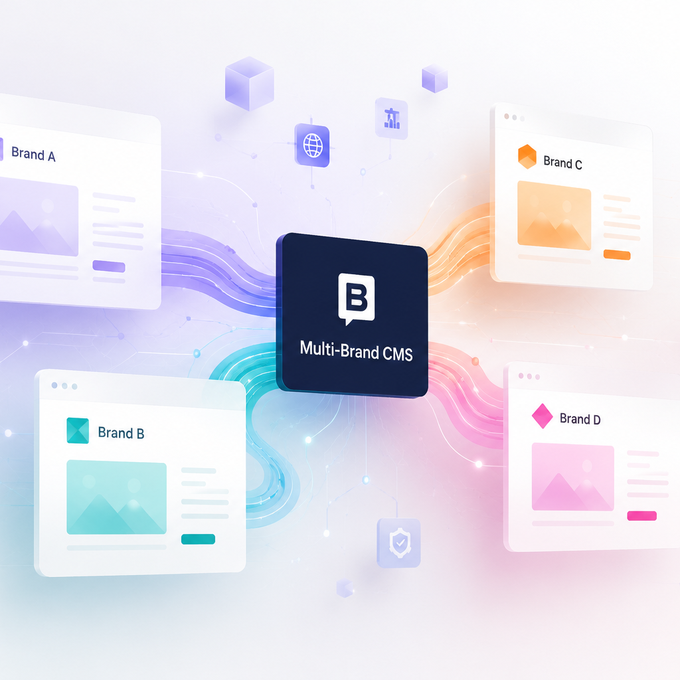
Multi-brand goes further. A multi-brand CMS manages distinct brands with separate identities, audiences, and content strategies, all from a single platform. Each brand maintains its own visual identity and editorial voice, while the organisation retains central governance and shared infrastructure.
Multi-tenant refers to the underlying architecture. In a multi-tenant CMS, each brand or business unit operates within an isolated environment (a "space" or "tenant"), with its own content, users, and permissions. Shared components and schemas can be pushed across tenants, but each operates independently day-to-day.
The distinction matters because the governance model is entirely different. Multi-site is a technical convenience. Multi-brand is an organisational strategy. Multi-tenant is the architecture that makes true brand separation possible at scale.
For enterprise organisations managing multiple brands across markets, the requirement is typically multi-brand with multi-tenant architecture. That combination delivers both the isolation brands need and the central control the business demands. An enterprise-grade headless CMS is purpose-built for this kind of multi-tenant separation.
The Enterprise Multi-Brand Challenge
Enterprise organisations rarely face a simple platform decision. The challenge is structural.
Consider a global building materials company like Kingspan. Multiple product brands operating across dozens of markets, each with localised content requirements, different compliance standards, and distinct audiences. The central team needs visibility and governance. The regional teams need autonomy and speed.
Before centralisation, a typical scenario involves separate CMS instances per brand or market. Each has its own hosting, its own developer support, and its own publishing workflows. Content that could be shared across brands is recreated manually. Design consistency depends on individual teams following guidelines, rather than systems enforcing them.
The problems compound:
- Content fragmentation across isolated platforms means updates take days instead of minutes
- Governance failures emerge because there's no single source of truth for brand assets, templates, or publishing standards
- Siloed teams duplicate effort, building the same components and content patterns independently
- Cost escalation from maintaining multiple platform licences, hosting environments, and specialist development teams
- Slow time-to-market for new brands or regions because every launch requires building from scratch
For Kingspan, we are currently consolidating multiple brands and markets onto a single headless CMS with a shared component library. Each brand retains its own identity and content, but the underlying architecture, components, and governance become shared infrastructure.
This pattern repeats across every multi-brand project we've delivered. The specific platforms and brands change, but the structural challenge is consistent.
The cost of inaction compounds annually. Each year a fragmented estate remains, the organisation pays for duplicate licences, duplicate hosting, duplicate development support, and duplicate training. The technical debt grows as each platform diverges further. Recruitment becomes harder because specialist skills are needed for each platform. And the gap between what marketing teams want to publish and what they can actually achieve widens.
Centralisation onto a multi-brand CMS isn't just a technology project. It's an operational transformation that affects content teams, marketing workflows, and technology architecture simultaneously. Organisations that treat it purely as a replatforming exercise tend to replicate existing problems on new infrastructure, rather than solving the underlying structural issues.
Architectural Approaches: Monolithic DXP vs Composable Stack
The first decision in any multi-brand platform project is architectural. Two fundamentally different approaches exist, and the choice shapes everything that follows.
Monolithic DXP (Digital Experience Platform) solutions like Adobe Experience Manager and Sitecore bundle CMS, personalisation, analytics, and digital asset management into a single integrated suite. They offer comprehensive functionality out of the box, with purpose-built multi-site management features.
Composable headless architecture separates the CMS from the presentation layer entirely. Platforms like Storyblok, Contentful, and Sanity manage content through APIs, while frontend frameworks (Astro, Next.js, Nuxt) handle rendering. Additional capabilities are added through best-of-breed integrations rather than a single vendor's suite.
The market is moving decisively toward composable. Over 80% of enterprises plan to adopt headless or composable architecture by 2026, according to industry research. The CMS market worth $22.9 billion in 2025, projected to reach $39.9 billion by 2034. Much of that growth is in headless and API-first platforms.
Neither approach is universally superior. The right choice depends on organisational context. Understanding the headless CMS architecture benefits helps clarify which model suits your organisation.
Monolithic DXP fits when:
- The organisation already has deep investment in a specific vendor ecosystem
- Tight integration between content, personalisation, and commerce is the primary requirement
- Internal teams have specialist skills in the platform (AEM developers, Sitecore architects)
- Budget allows for enterprise licensing and ongoing specialist support
Composable headless fits when:
- Multiple brands need separation with shared infrastructure
- Frontend flexibility matters (different brands may need different presentation approaches)
- Performance is a priority (headless architectures typically deliver better Core Web Vitals)
- The organisation wants to avoid vendor lock-in
- Cost predictability and scalability are concerns
For most multi-brand projects we encounter, composable headless delivers better outcomes. The separation between content management and presentation maps naturally to multi-brand requirements, where each brand needs its own identity but the underlying content architecture should be shared. Learn more about building scalable websites with headless CMS architecture.
The cost difference is also significant. Enterprise DXP licences typically range from $100,000 to $500,000+ annually before implementation costs. Composable platforms start lower and scale more predictably because each component can be sourced from the most cost-effective provider.
Performance is another differentiator. Headless architectures with static or server-rendered frontends consistently outperform monolithic platforms on Core Web Vitals. For multi-brand organisations where each brand competes for search visibility, this performance advantage compounds across every page and every brand in the portfolio.
What to Look for in a Multi-Brand CMS
Choosing a CMS for multi-brand is not the same as choosing one for a single website. The requirements expand significantly when multiple brands, teams, and markets are involved.
Content model flexibility is foundational. The CMS must support shared content types (a product page schema, a news article schema) while allowing brand-specific extensions. Rigid content models break when a new brand has requirements that don't fit the original structure.
Brand isolation ensures that teams working on one brand cannot accidentally modify or publish content for another. True isolation means separate content trees, separate media libraries, and separate publishing pipelines per brand.
Governance enforcement goes beyond permissions. The CMS should enforce brand standards through component design, not just user roles. Locked components, restricted styling options, and enforced content structures prevent brand drift at the system level.
Visual editing directly affects adoption. If marketing teams can't see what they're publishing without switching between a CMS backend and a preview environment, they'll find workarounds. A strong visual editor reduces the gap between content creation and published output.
Localisation architecture must support both language translation and regional content variation. These are different problems. A UK brand page translated into German is localisation. A completely different content strategy for the German market is regionalisation. The CMS needs to handle both.
Scalability at the multi-brand level means the platform doesn't slow down, become more expensive per unit, or require architectural changes when adding brands. Adding a new brand should be a configuration task, not a development project.
Frontend flexibility ensures the platform doesn't constrain presentation decisions. Different brands may require different frontend approaches. A headless CMS that delivers content via API allows each brand to choose its own frontend framework, design system implementation, and hosting approach.
Integration capabilities determine whether the CMS can connect to existing martech, commerce, and analytics systems. Enterprise organisations rarely operate a CMS in isolation. The platform must integrate with CRM systems, marketing automation, digital asset management, search tools, and analytics platforms without requiring custom middleware for every connection.
Developer experience affects implementation speed and ongoing maintenance cost. A CMS with clear documentation, modern APIs, and strong SDK support reduces development time and makes it easier to recruit and retain technical talent.
These criteria form the decision framework. Weight them according to your specific organisational context, but none should be ignored entirely.
Comparing Enterprise CMS Platforms for Multi-Brand
Six platforms consistently appear in enterprise multi-brand evaluations. Each has distinct strengths and limitations.
Platform | Architecture | Visual Editor | Multi-Brand Model | Best For |
|---|---|---|---|---|
Storyblok | Headless | Best-in-class | Multi-space | Marketing-led organisations needing brand separation with editorial independence |
Contentful | Headless | No native visual editor | Spaces + environments | Developer-led organisations with strong API requirements |
Sanity | Headless | Customisable (Sanity Studio) | Custom implementation | Teams needing maximum customisation and real-time collaboration |
Hygraph | Headless | Basic | Environments | GraphQL-native projects with content federation needs |
Adobe AEM | DXP (hybrid) | Integrated | Multi-Site Manager | Organisations already invested in Adobe ecosystem |
Sitecore | DXP (hybrid) | Integrated | Multi-site | Organisations requiring advanced personalisation at scale |
Storyblok
Storyblok's component-based content model maps naturally to multi-brand architectures. Each brand operates in its own Space with isolated content, users, and permissions. The visual editor is genuinely best-in-class, allowing marketing teams to build and publish pages without developer involvement.
Space Blueprints enable rapid deployment of new brands by cloning a predefined content structure, components, and configurations. FlowMotion workflows provide publishing governance within each space.
The component model is what makes Storyblok particularly strong for multi-brand. Shared components can be defined centrally and deployed across spaces, ensuring structural consistency while allowing brand-specific styling through design tokens.
The primary concern is pricing. Storyblok charges per space, which means costs scale linearly with each additional brand. For organisations with many brands, this requires careful commercial planning.
Contentful
Contentful is a mature, API-first CMS with a strong enterprise ecosystem. Its content model is flexible and well-documented. Spaces and environments provide brand separation, and the platform integrates well with virtually any frontend framework.
The significant limitation for multi-brand is the lack of a native visual editor. Content editors work in a structured backend interface, which creates a steeper learning curve for marketing teams accustomed to page-builder experiences. Contentful Experiences attempts to address this but remains less mature than Storyblok's visual editor. See our detailed Contentful vs Storyblok comparison for a full breakdown.
Contentful is expensive at enterprise scale. Pricing is based on spaces, environments, and API calls, which compounds quickly across multiple brands.
Best suited for developer-led organisations where editorial teams are comfortable working in structured content interfaces.
Sanity
Sanity offers maximum customisation through its open-source Sanity Studio. The content model is schema-driven and infinitely flexible. Real-time collaboration is native, and the platform's GROQ query language provides powerful content retrieval.
For multi-brand, Sanity requires more custom development. There's no out-of-the-box multi-space architecture. Brand separation must be implemented through dataset configuration and custom access controls.
Sanity excels when the organisation has strong development resources and specific requirements that off-the-shelf solutions don't address. The trade-off is a longer setup time and ongoing reliance on developers for content model changes.
Hygraph
Hygraph differentiates through its GraphQL-native API and content federation capabilities. Content can be sourced from multiple systems and presented through a unified API layer.
For multi-brand, Hygraph's model is less mature than Storyblok or Contentful. Brand separation relies on environments, and the visual editing capabilities are limited compared to competitors.
Best suited for projects where content federation (pulling content from multiple sources) is a primary requirement, or where GraphQL is already the standard in the development team.
Adobe AEM
Adobe Experience Manager is a comprehensive DXP with deep multi-site management capabilities. Its Multi-Site Manager allows content inheritance across sites, with the ability to override at any level. Integration with the wider Adobe ecosystem (Analytics, Target, Commerce) provides a complete digital experience suite.
The trade-offs are significant. AEM requires specialist developers (expensive and scarce). Licensing costs are substantial. The platform is complex to configure and maintain. Performance can be challenging without significant optimisation effort.
AEM fits organisations already deeply invested in the Adobe ecosystem, where the integration benefits justify the cost and complexity.
Sitecore
Sitecore offers advanced personalisation and multi-site management, with strong workflow capabilities. Its experience platform combines CMS, personalisation, marketing automation, and commerce. Our Sitecore vs Storyblok comparison explores when each platform is the better fit.
Like AEM, Sitecore requires specialist developers (.NET background). The platform is complex, expensive, and carries significant ongoing maintenance overhead. The move to Sitecore XM Cloud has modernised the architecture, but the ecosystem remains specialist.
Sitecore fits organisations where personalisation at scale is the primary differentiator and where existing .NET expertise is available.
Why We Typically Choose Storyblok for Multi-Brand Projects
Our recommendation isn't absolute, but for most multi-brand projects we evaluate, Storyblok offers the strongest combination of capabilities.
The visual editor gives marketing teams independence. This is the single most important factor for multi-brand success. Marketing teams across different brands need to publish content without raising developer tickets. Storyblok's visual editor allows them to build pages from pre-approved components, preview in real-time, and publish with confidence. No other headless CMS matches this capability.
The component model maps directly to shared libraries. Multi-brand architectures need shared structural components with brand-specific styling. Storyblok's nested component model supports exactly this pattern. A "Hero" component can have a fixed structure (heading, body, image, CTA) while each brand applies its own design tokens for typography, colour, and spacing.
Multi-space architecture provides flexible brand isolation. For most projects, we manage multiple brands within a single Space, using content folders and permissions to maintain separation. For larger enterprise organisations, we split major divisions into separate brands, or allocate a dedicated Space per brand when scale demands it. The advantage is architectural flexibility: shared components and assets can be deployed across Spaces, ensuring consistency while maintaining brand independence. New brands can be deployed from Space Blueprints in hours rather than weeks. The trade-off is cost per-space pricing means more spaces increase licensing fees, but the ability to match the architecture to your specific scale and governance requirements makes this a strategic decision rather than a technical constraint.
Storyblok pairs well with performance-focused frontends. We typically combine Storyblok with Astro, delivering static or server-rendered pages with minimal JavaScript overhead. This results in strong Core Web Vitals scores, better SEO performance, and faster page loads across all brands.
Migration paths from legacy platforms are well-established. Moving from AEM, Sitecore, or Umbraco to Storyblok follows a proven methodology. Content can be migrated programmatically, and the component-based model accommodates complex legacy content structures.
We're transparent about limitations. Per-space pricing requires careful planning for organisations with many brands. Native cross-space workflows don't yet exist, meaning content that needs to move between brands requires custom integration. For highly personalised experiences, Storyblok relies on third-party integrations rather than native personalisation.
These limitations haven't prevented successful delivery on any project we've undertaken, but they require acknowledgement during platform evaluation. Explore our Storyblok development services to see how we deliver these projects.
The decision often comes down to who needs to manage the platform day-to-day. Platforms where marketing teams can operate independently (creating pages, publishing content, managing campaigns) without constant developer involvement deliver better long-term ROI. Storyblok's visual editor makes this possible in a way that other headless CMS platforms currently cannot match.
Design Systems and Shared Component Libraries
A multi-brand CMS without a shared component library is just multiple single-brand sites on shared infrastructure. The real value comes from building once and deploying everywhere.
The component library is the bridge between brand consistency and brand independence. Structural components (page layouts, content blocks, navigation patterns, form modules) are built once with defined content structures, interaction patterns, and accessibility standards. Brand-specific styling is applied through design tokens, not through rebuilding components.
Design tokens control the visual layer: typography scales, colour palettes, spacing systems, border treatments, and animation patterns. Each brand defines its own token set. The same "Card" component renders differently for each brand without any structural code changes.
This approach delivers three critical benefits for multi-brand organisations:
- Speed: New brands launch in weeks rather than months because the structural work is already done. Only brand tokens and brand-specific content need to be created.
- Consistency: Governance is built into the component model. Teams can't accidentally break page structures or accessibility standards because those constraints are encoded in the components.
- Efficiency: Bug fixes, accessibility improvements, and performance optimisations apply across all brands simultaneously. One update to a shared component improves every brand.
In practice, we typically structure component libraries at three levels. Foundation components handle layout, spacing, and typography. Content components manage specific content patterns (hero sections, feature grids, testimonial blocks). Brand override layers apply visual customisation through tokens.
For the Kingspan project, we are building a shared component library that serves multiple product brands across multiple markets. Each brand maintains its distinct visual identity, but the underlying component structure, content model, and governance rules are shared across the platform.
No competitor CMS fully replicates this pattern without a deliberate architectural approach. The CMS provides the content structure and editing experience. The design system and component library provide the multi-brand scaling mechanism. Both are essential.
The investment in a shared component library pays for itself within the first brand expansion. Building a new brand from an existing library typically costs 40-60% less than building from scratch. Each subsequent brand costs even less because the library matures with every project.
Documentation is critical. Every component needs clear specifications covering its purpose, accepted content, configuration options, and brand override capabilities. Without documentation, the component library becomes tribal knowledge that only the original development team understands.
Content Modelling for Multi-Brand Platforms
Content modelling for multi-brand is more complex than single-site work. The challenge is defining schemas that are flexible enough for brand variation without becoming so generic they lose meaning.
Start with shared content types. Identify the structural patterns that every brand needs: pages, articles, product listings, team members, case studies. These form the shared foundation. Each brand will create content within these types, but the structure remains consistent.
Allow brand-specific extensions. Some brands will have content requirements that don't apply to others. A B2B brand might need technical specification sheets. A consumer brand might need recipe pages. These should exist as brand-specific content types, not awkward extensions of shared ones.
Use composable components within content types. Rather than creating rigid page templates, define content types as containers for reusable components. A "Page" content type contains a flexible body field that accepts any component from the approved library. This gives editorial teams flexibility while maintaining structural governance.
Define relationships carefully. Cross-brand content relationships (a parent company page linking to subsidiary brand content) need explicit modelling. Avoid implicit relationships that break when content is moved or archived.
Don't over-engineer. A common mistake in multi-brand content modelling is excessive abstraction. Not every content type needs to accommodate every possible future brand. Start with what's needed now, with clear extension points for the future. Overly complex schemas slow down editorial teams and make CMS training harder.
The content model should be documented, versioned, and reviewed as part of platform governance. Changes to shared content types affect all brands, so they require careful consideration and testing before deployment.
In practice, we version content models alongside code. Schema changes go through pull requests, are reviewed by both developers and content strategists, and are tested against existing content before deployment. This prevents the "schema drift" that occurs when content model changes are made ad hoc without considering downstream effects across brands.
A well-designed content model also improves AI discoverability. Structured content with clear semantic relationships, proper metadata, and consistent naming conventions makes it easier for AI systems to understand, index, and surface content in AI-powered search results.
Governance, Workflows, and Permissions in Practice
Governance is where multi-brand platforms succeed or fail long-term. Technology enables multi-brand content management. Governance ensures it stays consistent and compliant over time.
Role-based access must operate at the brand level. A content editor for Brand A should not have access to Brand B's content, media, or publishing controls. In Storyblok, this maps to space-level roles and permissions. Each space has its own user roster and role configuration. Users can belong to multiple spaces with different permission levels.
Publishing workflows prevent unauthorised content from going live. For enterprise multi-brand, workflows typically include draft, review, and publish stages with role-based approvals. Storyblok's FlowMotion provides configurable workflows per space, with scheduled publishing and content staging.
Locked shared components prevent brand teams from modifying structural elements. When a component is centrally managed (navigation, footer, compliance notices), local teams should be able to populate content but not alter the component's structure. This enforcement happens at the component definition level.
Localisation workflows add another dimension. Content requiring translation needs a clear path from source language to translated versions, with review stages for quality assurance. Storyblok supports field-level translation and translatable/non-translatable field configuration, which reduces the volume of content that needs translation management.
Where additional tooling is typically needed:
- Cross-brand content approval for content that appears across multiple brands requires custom workflow integration. No headless CMS provides this natively.
- Compliance monitoring for regulated industries may require integration with external compliance tools that scan content before publication.
- Analytics-driven governance (identifying outdated content, low-performing pages, or brand drift) requires integration between the CMS and analytics platforms.
Governance is not a one-time configuration. It requires ongoing attention as brands evolve, teams change, and new markets are added. The platform should make governance easy to maintain, not just easy to set up initially. Storyblok's enterprise governance and security features are designed for this ongoing requirement.
We recommend quarterly governance reviews for multi-brand platforms. These reviews should cover user access audits, workflow effectiveness, component library health, and content quality across brands. Organisations that skip these reviews typically discover governance has degraded only when something goes visibly wrong, such as a brand-inconsistent page going live or sensitive content appearing on the wrong brand's site.
Training is the other half of governance. Every new team member needs onboarding that covers not just "how to publish" but "why the platform works this way." Understanding the governance model helps teams work within it willingly rather than trying to circumvent controls they don't understand.
Migration: Moving from Legacy Platforms
Migration from legacy CMS platforms to a modern multi-brand architecture follows a consistent methodology, regardless of the source platform.
Phase 1: Audit and discovery. Map existing content across all brands and markets. Identify what content exists, what's still relevant, what's duplicated, and what can be retired. This typically reveals that 30-50% of existing content is outdated, duplicated, or unused.
Phase 2: Content model design. Define the target content model based on actual content requirements, not the legacy platform's structure. This is the most important phase. A well-designed content model simplifies everything that follows.
Phase 3: Component library build. Develop the shared component library and design system. Build components against the target content model, with brand tokens for each brand being migrated.
Phase 4: Migrate by brand. Migrate brands individually, starting with a pilot brand that exercises the full component library. Programmatic migration tools move structured content. Manual curation handles content that requires editorial decisions.
Phase 5: Cutover and decommission. Redirect legacy URLs, switch DNS, and decommission legacy platforms. Maintain redirects for SEO continuity.
Timelines vary significantly based on scope:
- Single-market, single-brand migration: 3-6 months
- Multi-market, single-brand with localisation: 6-9 months
- Enterprise multi-brand, multi-region platform: 9-12 months
Investment ranges depend on complexity and scope:
Common pitfalls include underestimating content audit effort, trying to migrate too many brands simultaneously, replicating legacy structures in the new platform instead of redesigning, and insufficient training for editorial teams. Our Umbraco to Storyblok migration case study illustrates how we approach these challenges in practice.
Frontend framework choice significantly affects performance outcomes. We choose Astro for most multi-brand projects because it delivers minimal JavaScript by default, resulting in stronger Core Web Vitals than React-heavy alternatives. Static generation and server-side rendering options provide flexibility per route or per brand.
SEO continuity is non-negotiable during migration. Comprehensive redirect mapping from legacy URLs to new URL structures preserves search equity. We typically see a brief ranking fluctuation during migration (2-4 weeks), followed by improvement as the new platform's better performance and structure take effect. Organisations that skip redirect planning can lose years of accumulated search authority overnight.
Training and handover should be built into the migration timeline, not bolted on at the end. Content teams need hands-on training with the new platform before go-live, not a documentation pack delivered on launch day. We schedule training sessions during the migration phase so teams can practice with real content in a staging environment.
Conclusion
Platform choice for multi-brand is fundamentally an architecture decision. It determines how content is structured, how brands maintain independence, how governance is enforced, and how the platform scales over time.
For most enterprise multi-brand projects, a composable headless approach delivers more flexibility, better performance, and lower long-term cost than traditional DXP platforms. The combination of a headless CMS (Storyblok, in most cases), a shared component library, and a well-designed content model provides the foundation for true multi-brand scale. The future of headless CMS points toward even greater composability and flexibility.
The organisations that succeed with multi-brand platforms invest in the architecture and governance decisions early, rather than treating the CMS as a simple content repository. Platform, design system, and content model work together as a single system.
Starting with the right architecture doesn't guarantee success. But starting with the wrong architecture guarantees friction, rework, and escalating costs as the platform grows. The decision is worth getting right from the outset.
Get in Touch
Planning a multi-brand platform project or evaluating CMS options for your organisation? We work with enterprise teams to design, build, and deliver multi-brand platforms that scale. Get in touch to discuss your requirements with our team.
Frequently asked questions
What Is the Difference Between Multi-Site and Multi-Brand CMS?
Multi-site refers to a single CMS instance powering multiple websites. Multi-brand specifically involves managing distinct brand identities with separate content strategies, audiences, and visual systems from a unified platform. Multi-brand typically requires stronger isolation between brands, including separate permissions, workflows, and publishing controls.
Should We Choose a DXP or a Composable Headless CMS?
A monolithic DXP (like AEM or Sitecore) makes sense when the organisation is already invested in that vendor's ecosystem and needs tight integration between content, personalisation, and commerce. A composable headless CMS (like Storyblok) is better suited when flexibility, performance, and cost predictability are priorities. Most multi-brand projects benefit from composable architecture because it naturally supports brand separation with shared infrastructure.
How Long Does a Multi-Brand CMS Migration Take?
For a single brand in a single market, expect 3-6 months. Multi-market projects with localisation typically require 6-9 months. Enterprise-scale multi-brand, multi-region migrations generally take 9-12 months. Timelines depend on content volume, number of integrations, and how much content redesign is required alongside the platform migration.
Can Non-Technical Teams Manage a Headless CMS?
With the right platform choice, absolutely. Storyblok's visual editor allows marketing teams to create, edit, and publish content without developer involvement. The visual interface shows exactly how content will appear on the live site. Other headless CMS platforms (Contentful, Sanity) require more technical comfort from editorial teams because they lack native visual editing.
What Role Do Design Systems Play in Multi-Brand Platforms?
Design systems are the scaling mechanism for multi-brand platforms. They define shared structural components (layouts, content blocks, navigation) that are built once and deployed across all brands. Brand-specific design tokens (colours, typography, spacing) are applied on top of shared structures, allowing each brand to look and feel distinct while sharing the same underlying architecture. Without a design system, each brand becomes a separate build project, eliminating the efficiency benefits of a shared platform.